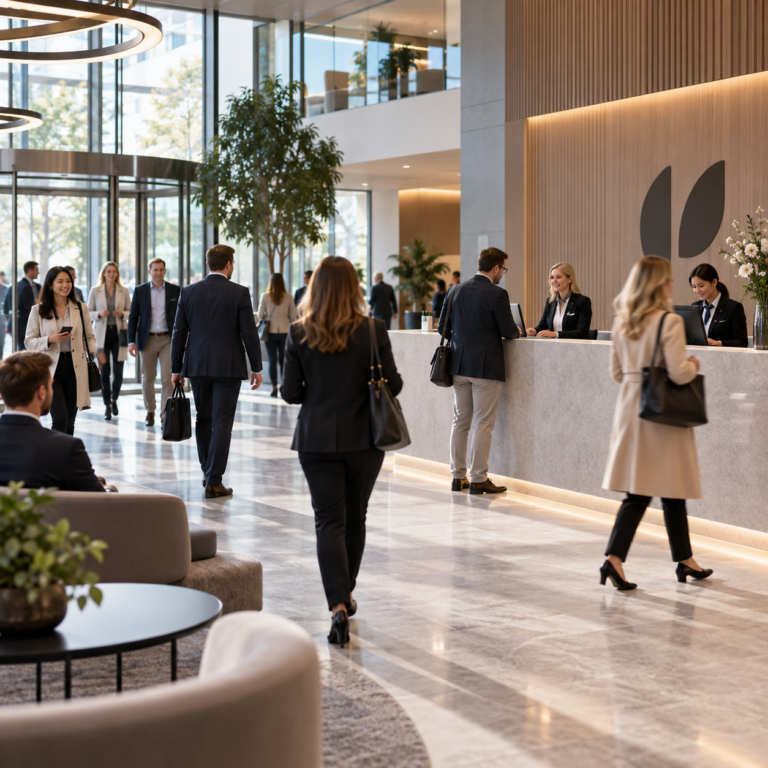

Fire safety is covered, doors are locked, and cameras are running. Everything looks secure. But in most cases, property security does not fail because of technology or structures. It fails because of people’s behavior. External visitors make that risk very real. Without clear visitor policies and processes, you cannot be sure who is moving around the property or why. At the same time, human error and careless shortcuts are given room to grow.
The three layers of property security
Property security is built on three layers: the physical environment, technological solutions, and human behavior.
The physical environment forms the foundation: materials, structures, locks, and access points. Technology adds the next layer with access control, surveillance, and other facility systems. These two layers are usually the easiest to recognize—and often receive the most attention.
The third layer is human behavior. It is almost always the weakest link.
Even with all the tools in the world and a secure building, people’s actions can still make a property unsafe.
Security does not come from systems or environment alone. It comes from how people use them—or fail to use them.
Every tool must bring real value to be worth using. Too much control and too many systems lead to shortcuts: doors are left open, processes are bypassed, and systems are ignored. In that case, security does not improve—it weakens. Too little control, on the other hand, increases risks. The optimal balance lies where security, usability, and maintainability meet—and this is where visitor management plays a key role.
Human behavior creates risks
The biggest security risks rarely come from a lack of systems. They come from how people act around them. And those risks become especially visible when visitors enter the picture.
Unauthorized people gain access.
Hybrid threats have become more common. Someone dresses in a maintenance uniform, walks in, and connects to the internal network. Once inside, they may gain access to systems that are protected from the outside. This is not a new phenomenon: Talouselämä has reported how security auditors have gained access by posing as maintenance workers and received access badges surprisingly easily—often thanks to simple politeness. This is not a theory. It is a real and growing threat.
In emergencies, no one knows who is on-site.
In many organizations, safety processes are designed for employees, and visitors are forgotten. A single property may have hundreds of visitors at the same time, with no records of them anywhere. When a fire breaks out, how do you know who is inside and how to reach them? How do you ensure everyone has left?
Visitors are not properly inducted.
A factory, a laboratory, a law firm—every environment has practices that visitors must follow. The more critical the environment, the more important it is that visitors know the rules in advance. If safety induction is not provided and verified, responsibilities remain unclear and risks easily materialize. In certain environments, this can even be life-threatening.
Data protection is violated—often unknowingly.
If a visitor’s name is written on paper or stored in Excel without proper data protection practices, the law is broken. The next visitor should not be able to see previous visitors’ information during sign-in, and every visitor has the right to know where their data is stored and how long it is retained. Even though GDPR violations can result in fines of up to 4% of annual revenue, this is still everyday practice at many front desks.
A standardized visitor path creates safety
Safe and smooth visits do not happen by accident. The visitor path should be designed in three stages:
- Before the visit, the visitor receives arrival instructions, completes the safety induction, and accepts the necessary documents. Everything is done in advance, on their own phone, so the front desk doesn’t get crowded with paperwork. The visitor arrives prepared and feels less stressed. There are things worth worrying about—finding your way should not be one of them.
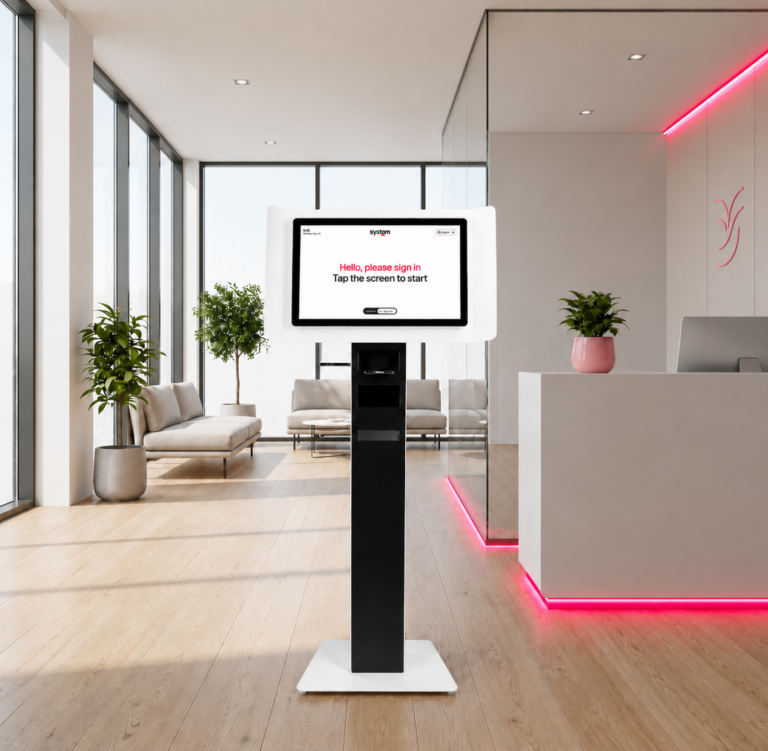
- During the visit, the process must be fast and seamless, but also secure. Visitor information can be shared with the front desk in advance. At sign-in, the digital identity is linked to the physical person, and the visitor receives a badge based on their profile. The host is notified of the arrival. This frees front desk staff from manual sign-in tasks and allows more time for creating a high-quality visitor experience and handling more important assistant tasks.
- After the visit, a controlled sign-out ensures the visitor has left. This prevents “ghost visitors” from remaining in the system. In case of an emergency, a single click can send an emergency notification to everyone on-site directly to their phones.
Responsibility cannot be outsourced—but it can be made easier
Ultimately, responsibility for the visitor always lies with the host. They invited the visitor, so it is their responsibility to ensure the visitor knows how to act and stay safe.
Digital visitor management does not remove this responsibility—it makes it easier to carry. When the visitor has completed safety induction and signed documents before arrival, responsibilities are clearly defined. At the same time, the host can be confident that the visitor understands the rules.
There is also one perspective that is often overlooked: employees’ right to a safe working environment. Employees should feel that the people moving around the property belong there, and that personal belongings can be left on the desk without worry. When visitor management is in place, that sense of safety comes naturally.
Security increases. Encounters remain.
EU regulation is tightening, and security requirements are increasing across all industries. At the same time, people are returning to offices—and for good reason. Studies show that teams perform better together, ideas are born in face-to-face encounters, and salespeople achieve better results when meeting customers in person. Physical presence is not a trend. It is a human need. But it must be safe and smooth.
We want to make workplaces safer and smarter—places where face-to-face meetings matter. That’s where we can help.
We at Systam bring technology and people together.